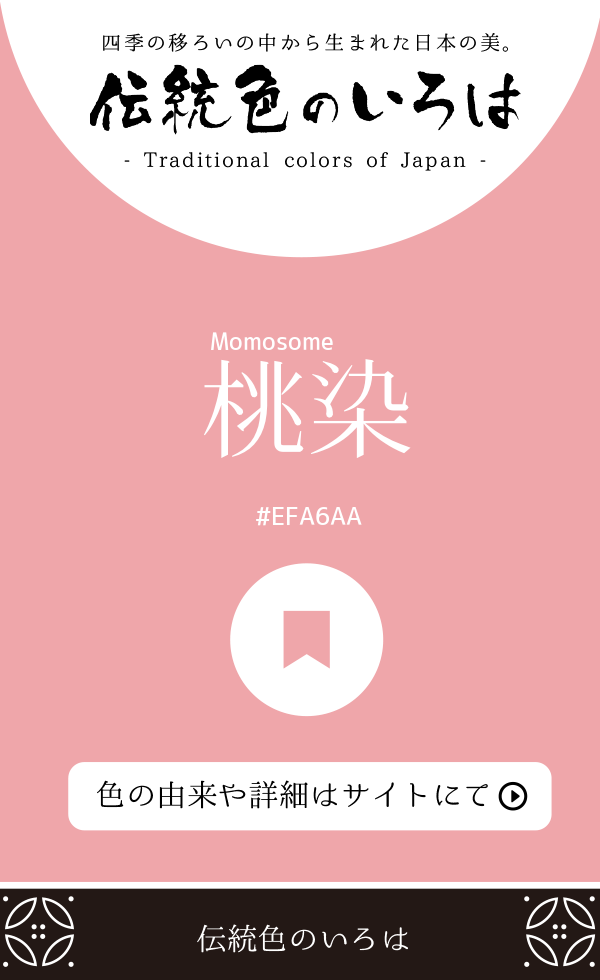
| 色の名前Japan Color Name | 桃染(ももそめ) |
|---|---|
| ローマ字Romanized | Momosome |
| RGB | R:239 G:166 B:170 |
| CMYK | C:07 M:46 Y:24 K:00 |
| Web カラーHex triplet |
色の説明
桃染(ももそめ)とは、桃の花のような明るく淡い紅色のことです。白鳳時代 に見られる古代の色名で、『つきそめ』『つき』とも読まれます。『桃花褐 』『桃花染 』とも書かれ、現代の『桃色』にあたる色です。
「日本書紀」の天智天皇六年(六六七)の条に「緋廿四匹 ・紺布廿四端 ・桃染布五十八端」と記されており、『桃染』は『緋』『紺』と並ぶ極めて古い色名でした。
※ 匹:布地二反を数える単位。端:布の長さの単位。反に同じ。
なお、「延喜縫殿式 」には「末額 は桃染布衫 」との記述があり、下級の役人(末額)が着る色として位置づけられていたことがわかります。
また、同じく「延喜縫殿式」には『退紅 』と同色と記載されていますが、紅花の使用量から推測すると、厳密には『退紅』のほうが少し淡い色であったと考えられます。
『桃染』のような「桃」を冠する色名は、平安時代の襲 の色目 に見られる色を除いて、次第に姿を消していきます。
同系に『退紅』『薄紅』『浅紅』といった淡い紅系統の色名が複数あったことや、「桃」といっても紅花で染められるということも、色名として定着しにくかった一因でしょう。
なお、「桃」を冠する色が再び一般的な色名として登場するのは、室町末期の『桃色』まで待たなければなりません。
江戸時代の有職故実 「装束色彙 」(一七七八)では、『桃染』は桃の花の色のことで『浅紅』『桃色』と同じ色として整理されています。江戸時代になると染色技術の進化により色数が大きく増え、「桃」を冠する色も複数登場しましたが、『桃色』の登場により『桃染』は一般的な色ではなくなってしまいました。
※1:「装束色彙」江戸中期に書かれた有職故実の書籍
現在でも『桃染』の名はほとんど使われませんが、その色は『桃色』として私たちの身近に残っています。『桃染』は、名称こそ変わりましたが、はるか古代より日本に伝わる確かな色といえるでしょう。

-読み:ももそめ-
関連する色の紹介
[Explanation of a color]
Momozome refers to a bright, pale crimson color reminiscent of peach blossoms. It is an ancient color name that appears from the Hakuhō period, and was also read as tsukisome or simply tsuki. The color was written using various forms such as Tōka-arazome and Tōka-tsukisome, and corresponds closely to what is known today as momoiro (peach pink).
In the Nihon Shoki, in the entry for the sixth year of Emperor Tenji (667), the following record appears:
“24 pieces of hi, 24 lengths of indigo cloth, and 58 lengths of momozome cloth.”
From this, it is clear that momozome was already recognized as a color name from a very early period, alongside established colors such as hi and kon.
According to the Engi Nuidono-shiki, the phrase “makkō wa momozome nuno-hitoe” indicates that garments dyed in momozome were assigned to lower-ranking officials (makkō). This shows that momozome was positioned as a color worn by those of lower status. The same source also records momozome as being the same color as arazome (faded crimson). However, when considering the quantities of safflower dye specified in the Engi-shiki, it is likely that arazome was, strictly speaking, slightly paler in tone.
Color names containing the character “peach” (momo)—such as momozome—gradually fell out of use, with the exception of those found in the layered color combinations (kasane no irome) of the Heian period. One reason for this decline may be the emergence of several more widely used pale red color names of similar hue, such as arazome, usubeni (light crimson), and asagi-beni. In addition, although the name suggests peaches, the color itself was dyed with safflower rather than peach blossoms, and this disconnect may also have made the name less stable and less likely to take hold.
Colors bearing the name “peach” did not reappear as common color names until the late Muromachi period, when momoiro came into use.
In the Edo-period work on court costume and ceremonial practice, Shōzoku Shokui (1778), momozome is described as the color of peach blossoms and is organized as being equivalent to asagi-beni and momoiro. As dyeing techniques advanced during the Edo period, the number of recognized colors increased significantly, and several colors associated with peaches emerged. With the establishment of momoiro as a general color name, however, momozome ceased to be widely used.
Today, the name momozome is rarely encountered, yet the color itself continues to exist under the name momoiro. Though the name has changed, momozome can be regarded as a color that has been transmitted through Japanese history from ancient times to the present.
-read: Kaidou-iro-
参考書籍
- 長崎盛輝『新版 日本の伝統色 その色名と色調』青幻舎 ISBN-10:4861520711
- 吉岡幸雄『日本の色辞典』紫紅社 ISBN-10:4879405493
- 内田 広由紀『定本 和の色事典』視覚デザイン研究所 ISBN-10:4881082035
注意事項
表示されている色(RGB値)は色の名前に対するおおよそものです。色名によっては広範囲の色を指す場合や文献・書籍等によっては解釈が異なる場合もありますのでご了承ください。 ご利用の環境によっては、色が適切に表示されていない場合があります。
印刷などに伝統色を利用したい場合は、DICグラフィックス株式会社から発売されている日本の伝統色シリーズがオススメです。
 DIC 日本の伝統色 第9版
Pinterestでシェアする際にご利用ください。
サイト運営者からのお願い
このサイトが気に入った、役に立ったと思われた方は、Amazon・楽天で買い物をする際はぜひ下記のバナーをタップしてからお買い物をお願いいたします。

こちらからお買い物をしていただきますと、価格の1%相当のポイントがサイトに入ります。もちろんその分、高くなるようなことはありません。
いただいたポイントは今後のサイト運営のための書籍代や運営費、モチベーションにつながりますので、ご協力いただけますと嬉しいです。


