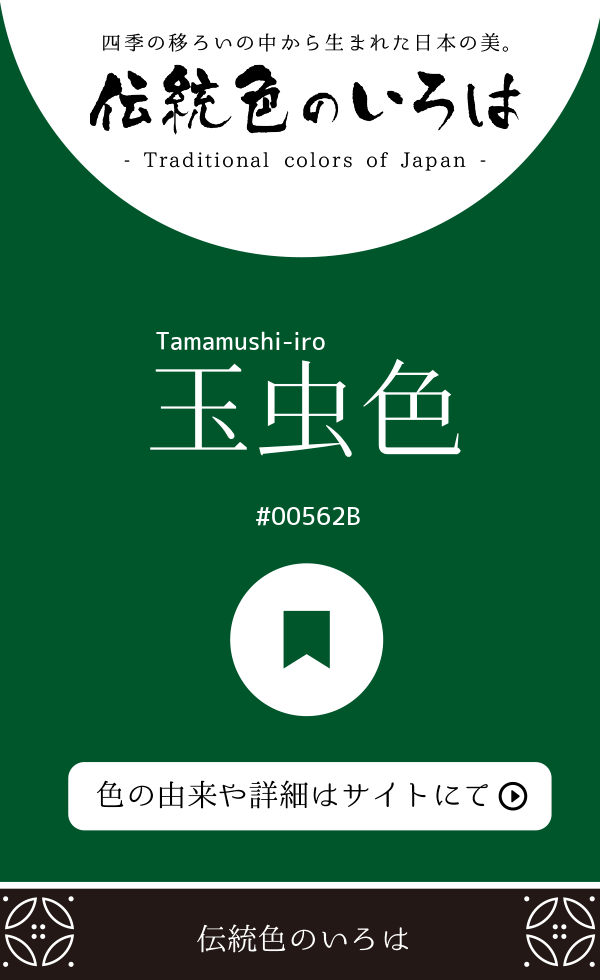
| 色の名前Japan Color Name | 玉虫色(たまむしいろ) |
|---|---|
| ローマ字Romanized | Tamamushi-iro |
| RGB | R:000 G:086 B:043 |
| CMYK | C:100 M:0 Y:88 K:60 |
| Web カラーHex triplet |
色の説明
玉虫色(たまむしいろ)とは、タマムシ(玉虫)という甲虫の翅 のような暗い青みのある緑色のことです。その名のとおりタマムシに由来する色で、『虫襖 』『夏虫色』は同色といわれます。
『玉虫色』はもともと「織り色」の色名で、経糸 に「青(現在でいう緑)」、緯糸 に「紫」を用いて織ることで、見る角度や光の当たり方によって色合いが変化し、タマムシの翅 のような独特の表情を生み出しました。
※織り色:経糸と緯糸の色の組み合わせによって生まれる色合いを指すもの。
『玉虫色』について「色名大辞典」(一九五◯)には、「…叉、中古服装襲 の色目の一つ。表は青黒、裏は二藍 叉は薄色 。」(一部抜粋)と記されています。
※襲の色目:衣の重ね着によって生まれる色合いを指すもの。
しかしこの内容は、鎌倉時代の装束 について解説した「雁衣抄 」の『虫襖 』の色目と内容的に一致しており、同書に付された「一説為玉虫色(一説には玉虫色とする)」という注記を踏まえて整理されたものと考えられます。
実際に雁衣抄では、『玉虫色』を襲の色目として確定するのではなく、その着用時期などによる呼称上の違いではないかと疑問形で記されています。さらに、他の装束資料にも『玉虫色』を襲の色目として立てる例は見られません。
以上の点を踏まえると、色名大辞典に見られる記述は、『玉虫色』という名の襲の色目が存在したことを示すものではなく、『虫襖』の説明を『玉虫色』の項にまとめた結果と見るのが妥当でしょう。
また、『玉虫色』については、襲の色目とは別に、重 の色目として整理された例も見られます。
「色目秘抄」には、「表青・裏紫」として記され、四季を通じて着用可能な配色とされていました。
※重の色目:衣の表・裏の裂を重ねて生まれる色合いを指すもの。
なお、『玉虫色』が一般的な色名として見られるようになるのは室町時代以降です。
タマムシ(玉虫)
タマムシは、タマムシ科に属する体長30~40mmの細長い米型の甲虫。全体に緑色の金属光沢があり、背中に虹のような赤と緑の縦じまが入る。美しい外見を持つことから古来より珍重されてきた。
タマムシの翅 は死後も色あせず、工芸品に加工されたり、装飾として使われたりしている。法隆寺宝物として知られる「玉虫厨子 」はその代表例。
タマムシの翅 は、光の角度によってさまざまな色へと表情を変えることから、いずれの立場とも取れる曖昧な対応や表現を指して「玉虫色」と呼ばれるようになりました。こうした背景から、現代では『玉虫色』は色名としてよりも慣用句として用いられる場面のほうが多く、タマムシそのものの生息数が減少していることと重ね合わせるように、色名の『玉虫色』もまた、静かに姿を消しつつあるのかもしれません。

タマムシ

-読み:たまむしいろ-
関連する色の紹介
[Explanation of a color]
Tamamushi-iro refers to a dark, bluish green reminiscent of the wings of the jewel beetle (tamamushi). As its name suggests, this color is derived from the appearance of the jewel beetle, and it is said to be identical to colors known as Mushiao and Natsumushi-iro.
Originally, Tamamushi-iro was a color name used for woven fabrics. By weaving blue warp threads (a hue corresponding to what we would now call green) with purple weft threads, the resulting cloth changed its appearance depending on the angle of view and the way light struck it, producing a distinctive effect similar to the iridescent wings of the jewel beetle.
Woven color refers to hues created through the combination of warp and weft thread colors.
Regarding Tamamushi-iro, the Dictionary of Color Names (195◯) records the following description:
“…also, one of the kasane no irome (layered color schemes) used in medieval court attire; the outer layer is blue-black, while the lining is futa-ai (double indigo) or usu-iro (pale color)” (excerpt).
Kasane no irome refers to a color system in which hues are expressed through the layering of garments.
However, this description corresponds closely to the color scheme of Mushiao as recorded in the Kariginu-shō, a treatise on court dress from the Kamakura period. In that text, Mushiao is accompanied by a marginal note stating, “isshō tamamusiiro to nasu” (“according to one theory, it is considered Tamamushi-iro”), and it appears that the entry in the Dictionary of Color Names was organized with this note in mind.
In fact, the Kariginu-shō does not definitively establish Tamamushi-iro as an independent kasane no irome, but instead presents it in an interrogative manner,
suggesting that the term may reflect a difference in naming depending on the season of wear. Furthermore, no other extant costume-related sources list Tamamushi-iro as a distinct layered color scheme.
From this, it is reasonable to conclude that the description found in the Dictionary of Color Names does not indicate the existence of a formally established kasane no irome named Tamamushi-iro, but rather represents an editorial consolidation in which the explanation of Mushiao was incorporated under the entry for Tamamushi-iro.
It was not until the Muromachi period that Tamamushi-iro began to appear as a commonly recognized color name.
The Jewel Beetle (Tamamushi)
The jewel beetle belongs to the family Buprestidae and is a slender, rice-shaped beetle measuring approximately 30–40 mm in length. Its body displays a vivid metallic green sheen, with iridescent red and green stripes running along its back. Owing to its striking appearance, it has been treasured since ancient times.
Remarkably, the wings of the jewel beetle do not fade even after death. For this reason, they have been used in crafts and decorative objects. The Tamamushi Shrine (Tamamushi no Zushi), a famous treasure of Hōryū-ji Temple, is a well-known example.
Because the beetle’s wings shift in color—appearing green, purple, or other hues depending on the angle of light—the term tamamushi-iro eventually came to be used metaphorically to describe ambiguous responses or expressions that can be interpreted in multiple ways. As a result, in modern usage, tamamushi-iro is more commonly recognized as an idiomatic expression than as a color name. In a quiet parallel to the declining population of the jewel beetle itself, tamamushi-iro as a color name may also be gradually fading from use.
-read: Tamamushi-iro -
参考書籍
- 長崎盛輝『新版 日本の伝統色 その色名と色調』青幻舎 ISBN-10:4861520711
- 吉岡幸雄『日本の色辞典』紫紅社 ISBN-10:4879405493
- 内田 広由紀『定本 和の色事典』視覚デザイン研究所 ISBN-10:4881082035
注意事項
表示されている色(RGB値)は色の名前に対するおおよそものです。色名によっては広範囲の色を指す場合や文献・書籍等によっては解釈が異なる場合もありますのでご了承ください。 ご利用の環境によっては、色が適切に表示されていない場合があります。
印刷などに伝統色を利用したい場合は、DICグラフィックス株式会社から発売されている日本の伝統色シリーズがオススメです。
 DIC 日本の伝統色 第9版
Pinterestでシェアする際にご利用ください。
サイト運営者からのお願い
このサイトが気に入った、役に立ったと思われた方は、Amazon・楽天で買い物をする際はぜひ下記のバナーをタップしてからお買い物をお願いいたします。

こちらからお買い物をしていただきますと、価格の1%相当のポイントがサイトに入ります。もちろんその分、高くなるようなことはありません。
いただいたポイントは今後のサイト運営のための書籍代や運営費、モチベーションにつながりますので、ご協力いただけますと嬉しいです。


